The Candle Batch Planner
Measure the jar, split the fill into wax and oil within the maximum, test the wick, and label only the hours a candle can safely keep
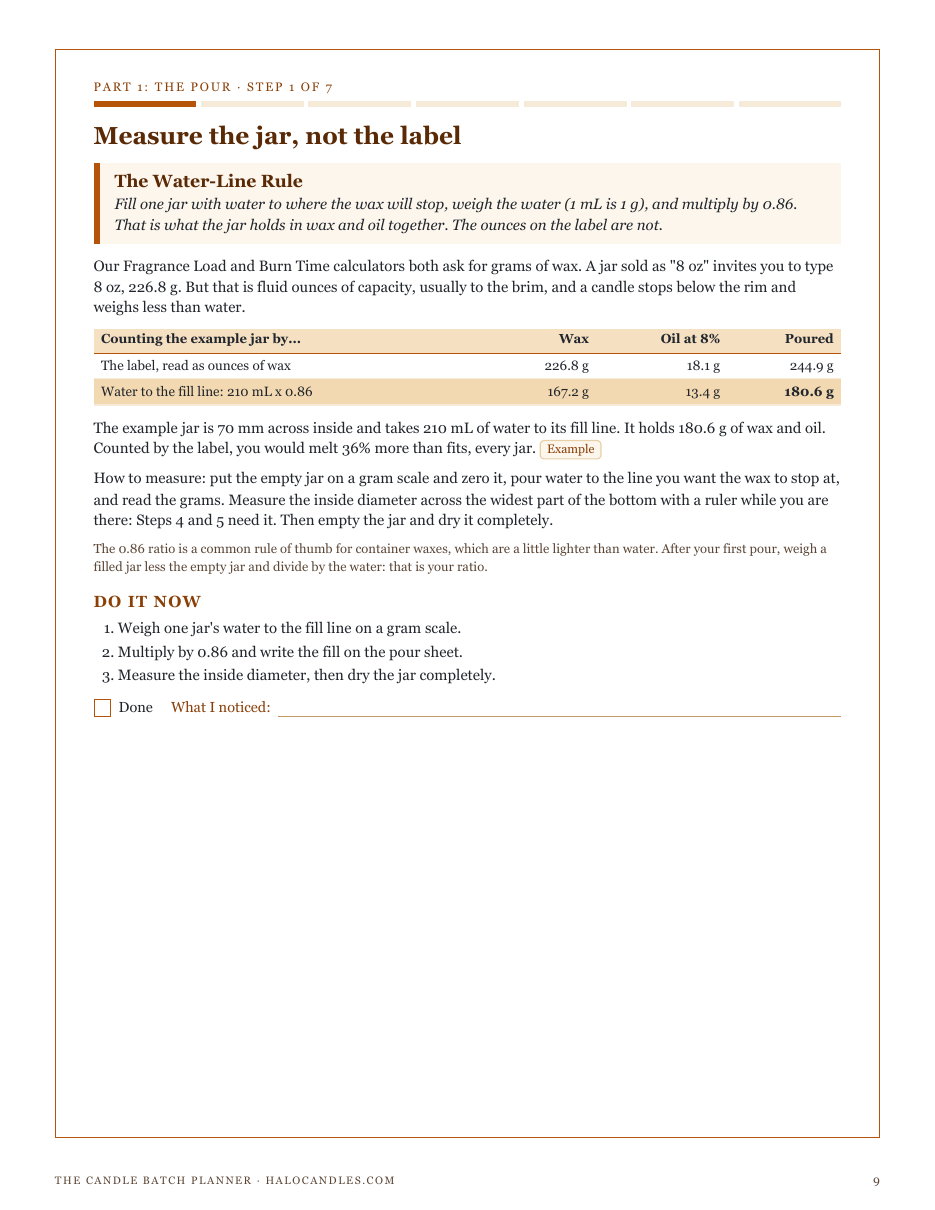
HaloCandles' free calculators each answer one question, and every one starts from grams of wax. But a maker holds a jar sold as "8 oz", and each answer feeds the next: the fill decides the oil, the jar decides the wick, the wick decides the burn rate, and the burn rate decides the hours on the label. Writing this planner, we also found the Candle Burn Time Calculator dividing every gram of wax by the burn rate, when a container candle is finished with about half an inch of wax left (a 200 g candle in a 75 mm jar read 28.6 hours; it has 21.4 safe ones), and the Fragrance Load Calculator accepting any typed maximum as safe. Both are fixed. The Candle Batch Planner puts the tools in order. It measures the jar by water to its fill line, splits the fill into wax and fragrance oil within the lower of the wax and oil makers' maximum load, buys the batch with three test candles, tests the wick a size either side of our guide's start, counts the safe hours to the half-inch line from a measured burn rate, plans a first burn and four-hour sessions, and costs each safe hour. On the worked example, a jar sold as 8 oz holds 180.6 g, not 226.8 g; a batch of 12 needs 938 g less wax than buying by the label; and the candle burns 19 safe hours, not 32. Every figure is computed from HaloCandles' own calculators, and the worked figures are examples; the fill ratio and allowances are labeled rules of thumb. It adds the fire safety the free tools lack: never unattended, 12 in from anything that burns, away from children and pets, trim to 1/4 in, stop at 1/2 in, never water on a wax fire, and the makers' maximum load and flash point. It covers candles only, with no skin use or health claims. Inside: seven steps, a pour sheet, a test-burn log, a label and price sheet, a jar card, a burn card to include with every candle and a quickstart, plus a personalised sheet worked from the numbers you enter in the calculators.
Look inside
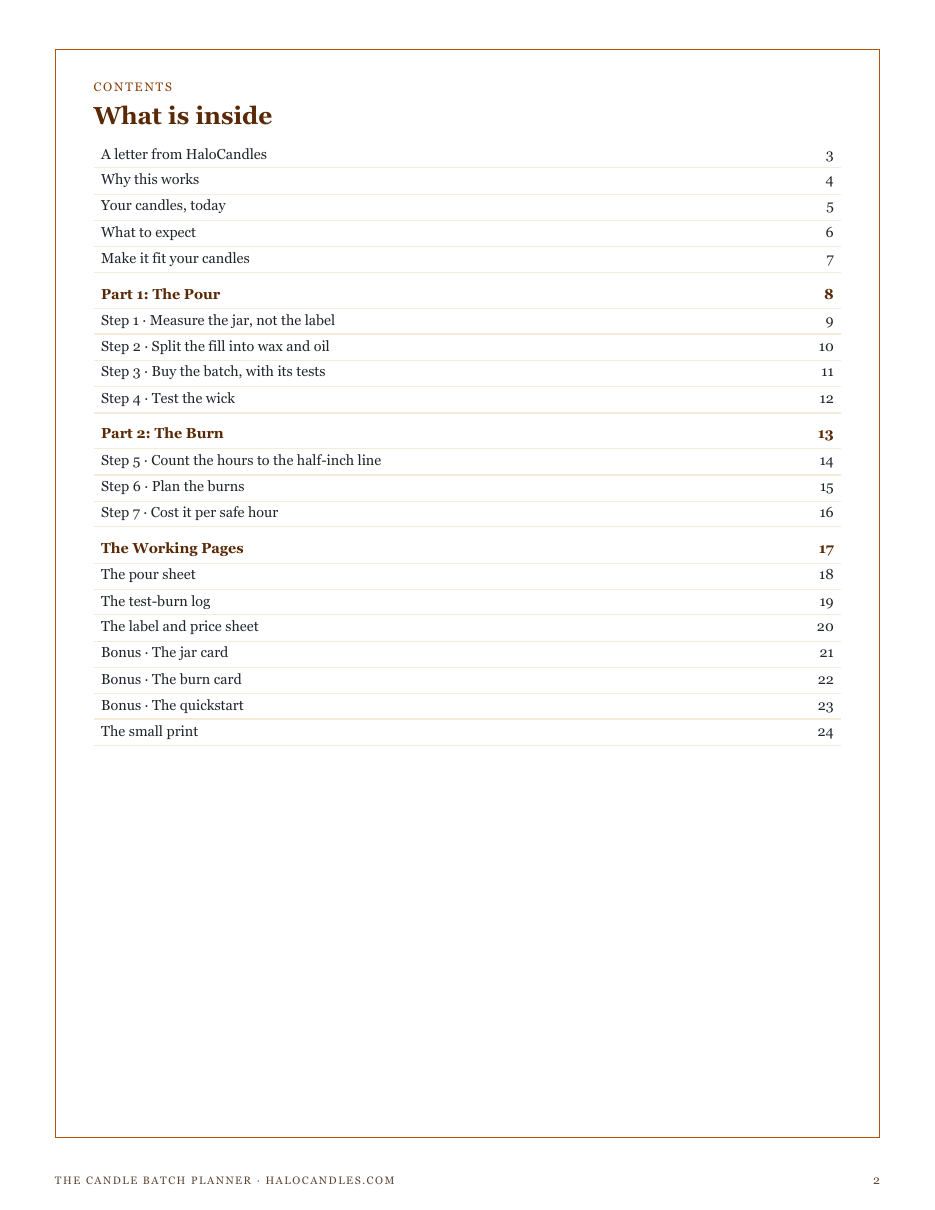
Two full pages from the planner, exactly as printed. Click either to read it at full size before you decide.
What is in it
- The Water-Line Rule: the jar measured by water to its fill line, not by the ounces on its label
- The Oil Goes Inside the Fill: wax and fragrance oil split at 6 to 12%, checked against the maker's maximum
- Buy for the Tests Too: the batch's wax and oil with three test candles, for 6 to 48 jars
- The Test Candle Decides: the start wick with one size down and one up, and a measured burn rate
- Stop at the Half-Inch Line: the safe hours for the label, rounded down, at five burn rates
- Four Hours, Then Trim: a first burn by diameter, four-hour sessions, and when a jar needs more wicks
- Price the Hours You Can Promise: the batch cost with its tests, the cost a candle and a safe hour
- The pour sheet and the test-burn log, printable
- The label and price sheet, and a jar card for 60 to 110 mm jars
- A burn card to include with every candle, and a one-page quickstart
- ✓ 24 printable pages
- ✓ 10 sections, worksheets and templates
- ✓ A second PDF worked out from the numbers you enter
- ✓ No account needed, just an email address
- ✓ Instant download; link valid 7 days
Price includes any taxes. Sold by GrabURL, who handle checkout and support. The charge appears on your statement as GrabURL.
The planner picks up where the free Candle Burn Time Calculator leaves off. The calculator divides wax by a burn rate; the planner starts from the jar, measured by water to its fill line, splits the fill into wax and oil within the maker's maximum with the Fragrance Load Calculator, tests the wick from the Candle Wick Size Guide, and counts the safe hours to the half-inch line for the label and the cost of each one. Never leave a burning candle unattended, keep it away from anything that burns and from children and pets, trim the wick to about 1/4 in, and stop when about 1/2 in of wax is left. It covers candles only, with no skin use or health claims. The worked figures are examples.